
“The future of climate justice must be collaborative, intersectional, and led by the next generation of inspired changemakers.”
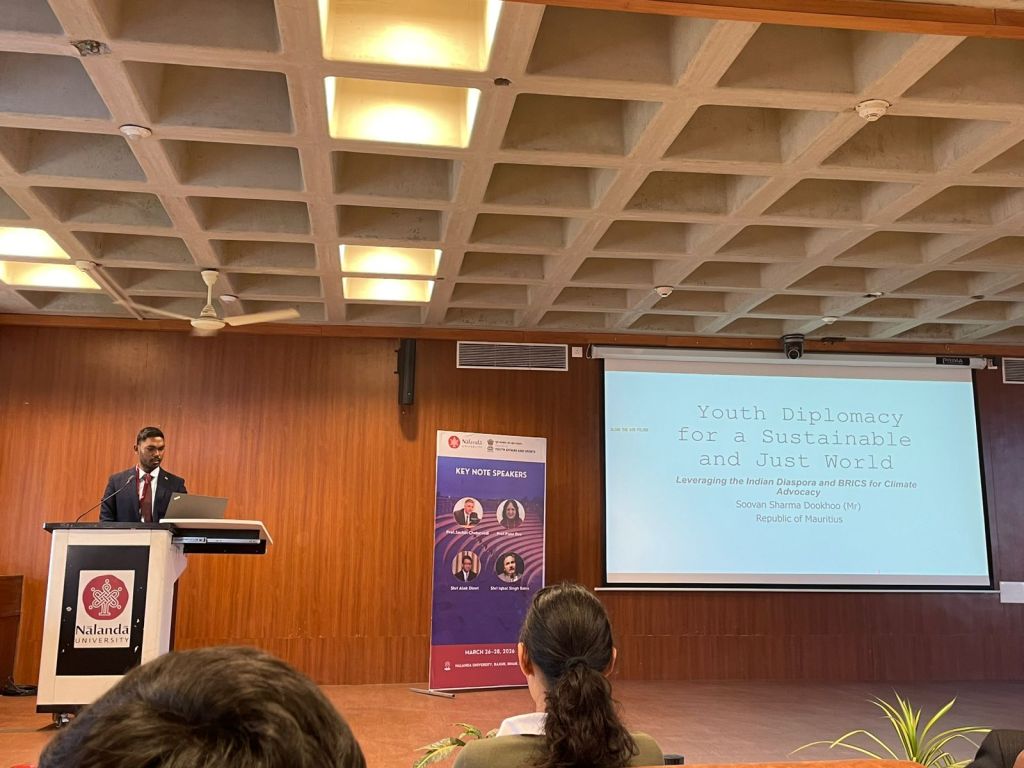
It was a profound honor to stand on the historic grounds of Nalanda University today a place that once served as the world’s epicenter of knowledge, to present my research paper: “Youth Diplomacy for a Sustainable and Just World: Leveraging the Indian Diaspora and BRICS for Climate Advocacy.”
Returning to this cradle of learning to discuss the “Emerging Paradigm of Youth Agency” felt like a full-circle moment. My research asserts that youth are no longer peripheral observers of international relations; we are the central protagonists in a new, networked, and multipolar world.
Redefining Diplomacy: Beyond State Borders
In my presentation, I explored how Youth Diplomacy has evolved into a sophisticated tool of “soft power.” By integrating the work of scholars, I argued that youth organizations are now conduits for forming a positive national image and diffusing new global norms.
The core of my research focuses on two powerful engines:
- The Indian Diaspora: A bridge between heritage and innovation, moving beyond biennial events to become active technical advisors in the Blue Economy.
- BRICS & SIDS Synergy: Channelling the economic weight of emerging powers to demand “Loss and Damage” reparations for vulnerable Small Island Developing States.
A Personal Mission: Radical Inclusion and Representation
A “Just World” is a prerequisite for a “Sustainable World,” but justice cannot exist without true representation. During the dialogue, I emphasized a critical pillar of my advocacy: the inclusion of persons with disabilities in the diplomatic process.
Drawing from my own experiences and advocacy, I highlighted that a “Just Transition” is often discussed in purely economic terms, yet it frequently ignores the Universal Design standards required for disaster risk reduction (DRR). In my paper, I propose a specific metric for success: the percentage of youth-led climate policies that contain accessibility standards. True diplomacy is not just about who is at the table, but whether the table itself is accessible to everyone. We must move beyond “Youth-Washing” and “Inclusion-Washing” to ensure that youth with disabilities are not just recipients of aid, but architects of policy.
The Road Ahead: From Activism to Institutional Power
The synthesis of Youth Diplomacy and social justice offers a blueprint for the future. As I shared with the faculty and fellow researchers at Nalanda, our goal is to move from “symbolic participation” to “systemic disruption.”
Our strategy for impact relies on three pillars:
- Iterative Empowerment: Turning raw activism into sustainable policy influence through mentorship.
- Multipolar Networking: Building bridges between the Global South and traditional power blocks.
- Intergenerational Knowledge: Combining the technical skills of youth with the Traditional Ecological Knowledge (TEK) of our elders in the diaspora.
I endorse Nalanda University, inspired by the insightful dialogue and ready to continue the work of ensuring that when heritage meets innovation, a sustainable and just world becomes an inevitability.
A Campus Designed for All: The Nalanda Model
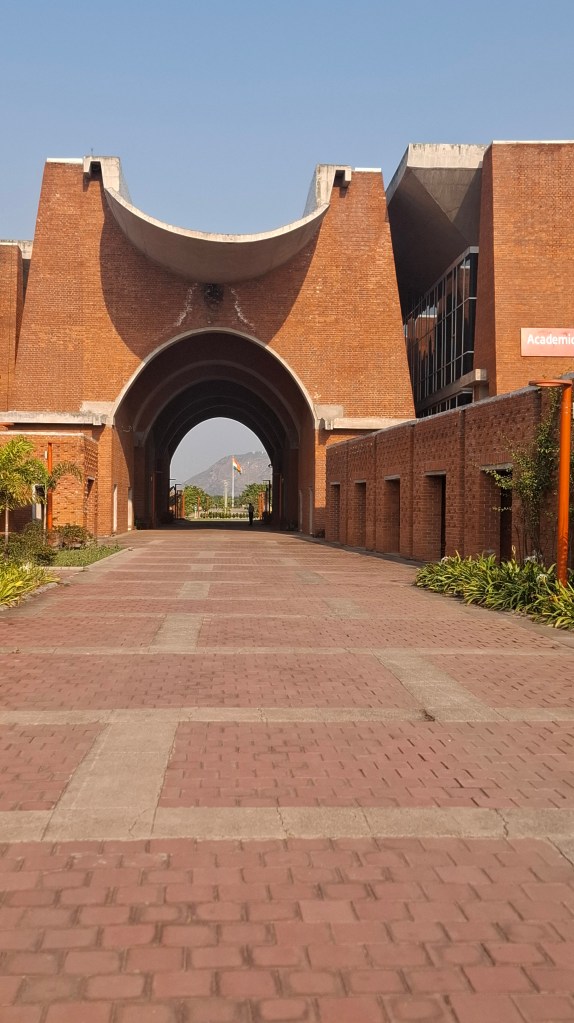
Beyond the academic discourse, being physically present at the new Nalanda campus was a revelation in inclusive architecture. Nalanda University Campus does not just lead in environmental sustainability; it sets a benchmark for accessibility. The campus is designed with a “human-centric” approach, featuring wide, barrier-free pathways, tactile paving for the visually impaired, and seamless ramp access to its iconic eco-friendly buildings. Seeing a world-class institution prioritize Universal Design, ensuring that students and researchers of all abilities can navigate the pursuit of knowledge independently, is a testament to what a “Just World” looks like in practice. It proves that the “Green Transition” and “Disability Inclusion” are two sides of the same coin.
#YouthDiplomacy #ClimateAction #NalandaUniversity #BRICS #SustainableFuture #Inclusion #HumanRights #GlobalSouth #DisabilityAdvocacy
References & Cross-Verification
- Acosta et al. (2018): On Transnational Youth Networks (TYNs) and the iterative process of empowerment.
- Shamkin, M.B. (2020): Regarding youth diplomacy as a tool for forming national image and soft power.
- Varpahovskis, E. (2017): Analysis of “Rhetoric Control” and “Norm Diffusion” in youth-led summits.
- UN Youth, Peace, and Security (YPS) Agenda: Foundational framework for youth as active partners in peacebuilding.
Author
Soovan Sharma Doohkoo
 Soovan Sharma Dookhoo